


A Bible reading plan only works if it survives contact with your actual week. Logos Reading Plans let you build one around your real schedule instead of an ideal one, and then the app does the remembering for you: it tracks your progress, syncs across desktop, web, and mobile, and gently nudges you when you fall behind instead of shaming you for it.
A quick note before we get into it: some of the Logos links below are affiliate links. If you buy through them, Logos Coach may earn a small commission at no extra cost to you. I only link to resources I’d point you to anyway.
Why a Reading Plan Is Worth Setting Up
Most people don’t quit a reading plan because the Bible got boring. They quit because the plan didn’t fit their life: too ambitious a pace, no way to catch up after a missed week, or a paper checklist that lived in a drawer instead of their pocket.
Logos Reading Plans solve the mechanical part of that problem. You choose the pace, the app tracks it everywhere you use Logos, and it’s built to flex when life happens instead of forcing you to start over.
Admittedly, I have not historically been one to be as disciplined with my reading plans as I have my running plans. There is something about the digital checklist that has not historically motivated me the same way that a bedside book does, reminding me to open up the pages and dig in before sleep, but the latest updates to the Logos application reading plan features does have me wanting to give it an honest try once again.
Here’s a look at a one I’m getting started myself thanks to the latest updates.

How to Set Up Your Reading Plan
1. Pick where you’ll start it
You can launch a new plan from several places in Logos, so use whichever is closest to what you’re already doing:
The New button on your Dashboard
The Reading Plan Manager
The Documents menu
The Tools tab inside a book you already have open
A right-click on any book title in your Library
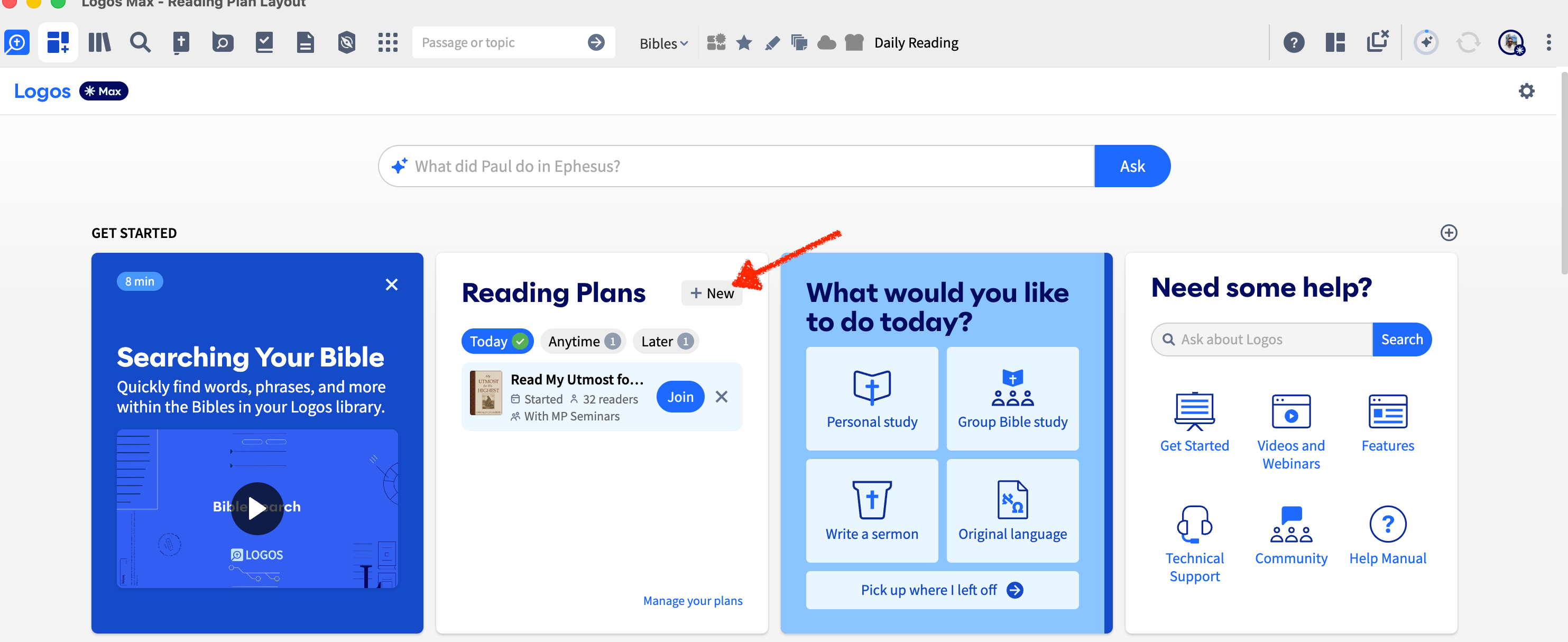
2. Choose what you’re actually going to read
Logos gives you real range here, so pick the option that matches your goal instead of defaulting to the biggest one:
A Bible plan, with your choice of version (Logos defaults to reading through the Bible in a year if you don’t change it)
A book from your Library, read whole or in a custom portion you set
A predefined, expert-curated plan if you’d rather follow someone else’s structure
An generated plan built from a goal and timeframe you give it (a helpful starting draft, not a substitute for you actually engaging the text as you go)
A fully custom plan built from a Passage List or a Clippings document
A group plan shared through a Faithlife Group, if you’re reading with other people
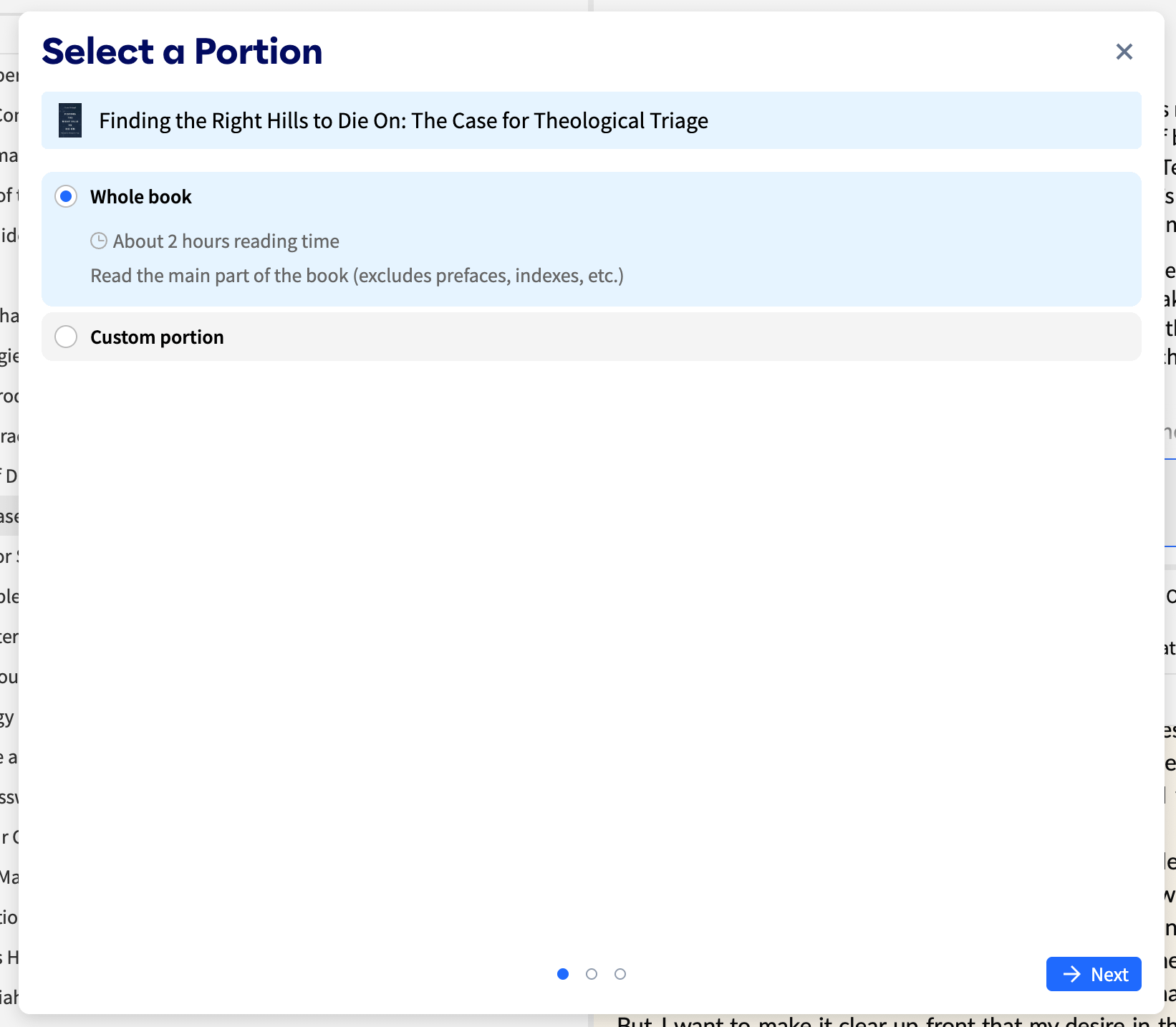
3. Set a pace you’ll keep, not the one that looks impressive
This is the step people rush past, and it’s the one that determines whether the plan survives past February. Logos lets you set:
A defined reading schedule with specific days, or no schedule at all if you’d rather read at your own pace without a calendar hanging over you
A goal type: a completion date, a daily time goal, or a target number of sessions
A start date and plan name
If you’re not sure, undersell yourself. A “no schedule” plan you finish beats a 365-day plan you abandon in March.
4. Turn on mobile notifications, but set the time honestly
Logos can send a push notification to remind you to read, and you choose the time. Pick the time you’re actually free, not the time you wish you were a morning person. A reminder that fires during your commute or your lunch break will get more of your attention than one that fires at 5:30 a.m. and gets swiped away half-asleep.
5. Let it track itself, and use the built-in recovery options
Once your plan is running, Logos handles the bookkeeping:
Sections you’re reading are marked with a blue ribbon so you always know where you are
A Mark done checkbox closes out each session
Your Dashboard shows a progress card so you can see how you’re doing at a glance
Progress and plan settings sync automatically across desktop, web, and mobile
If you miss a stretch of days (and you will), use Skip to latest to jump back to today’s reading instead of trying to cram in every missed day at once. A reading plan isn’t a debt you owe; it’s a habit you’re building.
6. Share it, if that helps you stay in it
If you’re reading with your family, a small group, or your whole church, you can share a plan by direct link, as a reusable template, or through a Faithlife Group. Community-reported experience on the Logos Community forums suggests a shared plan is one of the more effective ways people stick with a longer reading goal, since someone else is checking in too.
Common Questions
My reading plan isn’t showing up. What do I check first? Confirm you’re signed into the same Faithlife account on the device where you created the plan, then check your internet connection and make sure the app is updated to the current version. This is the kind of issue several users have reported on the Logos Community forums; if a straightforward account and connection check doesn’t resolve it, Logos Support (support.logos.com) can look at your specific account.
My progress isn’t syncing between my phone and my desktop. Sync depends on being signed into the same account on both devices and having a live internet connection on each. Give it a minute after you mark a session done; sync isn’t always instant. Community members have reported occasional sync delays, particularly after an app update, so if it’s still off after a few minutes, a restart of the app is a reasonable next low-risk step.
Can I build a plan around something other than the Bible itself? Yes. Pick any non-reference book in your Library and read it whole or in a custom portion, on whatever pace you set.
What if I fall behind for weeks, not just days? Use Skip to latest to jump forward, or switch your plan’s pace to “No schedule” if a fixed calendar is working against you instead of for you.
A Practical Example
Say you want to read through the Gospels this year, not the whole Bible, just the Gospels, at a pace you can actually keep on your lunch break. In Logos, you’d start a plan from your Library (or a predefined Gospels-focused plan if one fits), set the goal type to a number of daily minutes instead of a fixed page count, and turn on a notification for whatever time your lunch actually starts. When a hard week hits and you miss four days, Skip to latest gets you back to today instead of asking you to read three extra chapters to catch up.
Recommended Logos Resources
Logos Reading Plans: the feature this whole article is about. Start here to see the full range of Bible, Library, predefined, and custom plan options.
Logos Bible App: the mobile app is where your reminders and your on-the-go reading actually happen. Your reading plan is only as good as your ability to open it on the bus or in the pickup line.
ESV Study Bible (Bible and Notes): if you want a study-note layer while you read instead of the plain text alone, this is a solid resource to build a Library-based plan around.
A Closing Word
You don’t need a perfect streak to have a meaningful reading habit. You need a plan that bends when your week doesn’t go as planned, and a way to pick it back up without guilt when it doesn’t. That’s what this feature is actually for: not a scoreboard, a rhythm you can return to. Open Logos this week, start one plan, and let it track itself so you can spend your attention on the text instead of the bookkeeping.
Open Logos and start your first Reading Plan this week.